


Jake DeBrusk is getting shopped. Specifically the kind of mid-first a contender is dangling, like Columbus's pick at 14, or the picks in the 15-to-32 range that belong to teams already good enough to be drafting late. Half the people you talk to think trading a first for a winger like DeBrusk is not smart. I wanted to actually check it, so I did two things. I read his card to figure out what he really is, and then I ran a study on what picks in that range actually turn into.
What the card says DeBrusk is
Let me start with the player, because you can't price him without knowing what he does.
The card is really clear about his strengths. He's a shot generator (88), quality shot taker (86), high pace (92) winger with a power play grade of 100. Translate that out of analytical talk, he gets to dangerous areas, he shoots a ton from those areas, he does it at speed in transition, and he is an elite net front man on the powerplay. His on-ice impact sits at 75, so the team controls play when he's out there. That's a real top-six skill set, the kind of player who drives offense rather than just riding it.
His finishing graded a 5 this season, which is about as low as it goes, and his defense is a 22 with physicality at 35. He's a shoot-first guy whose playmaking is middling at 44. So you're buying a player who doesn't kill plays in his own end and isn't going to run anybody over.
Here's the part that matters most, though. He scored 23 goals on 34.9 expected goals. The model says, based on the volume and quality of his looks, he should have scored around 35. He scored 23. That's a player who got the chances and the puck didn't go in. Finishing is the noisiest skill in hockey, it bounces around year to year, while shot generation and shot quality are stable. DeBrusk is generating like a 30-goal scorer and finishing like a fourth-liner, and those two things almost never stay that far apart.
What he looks like in a different system
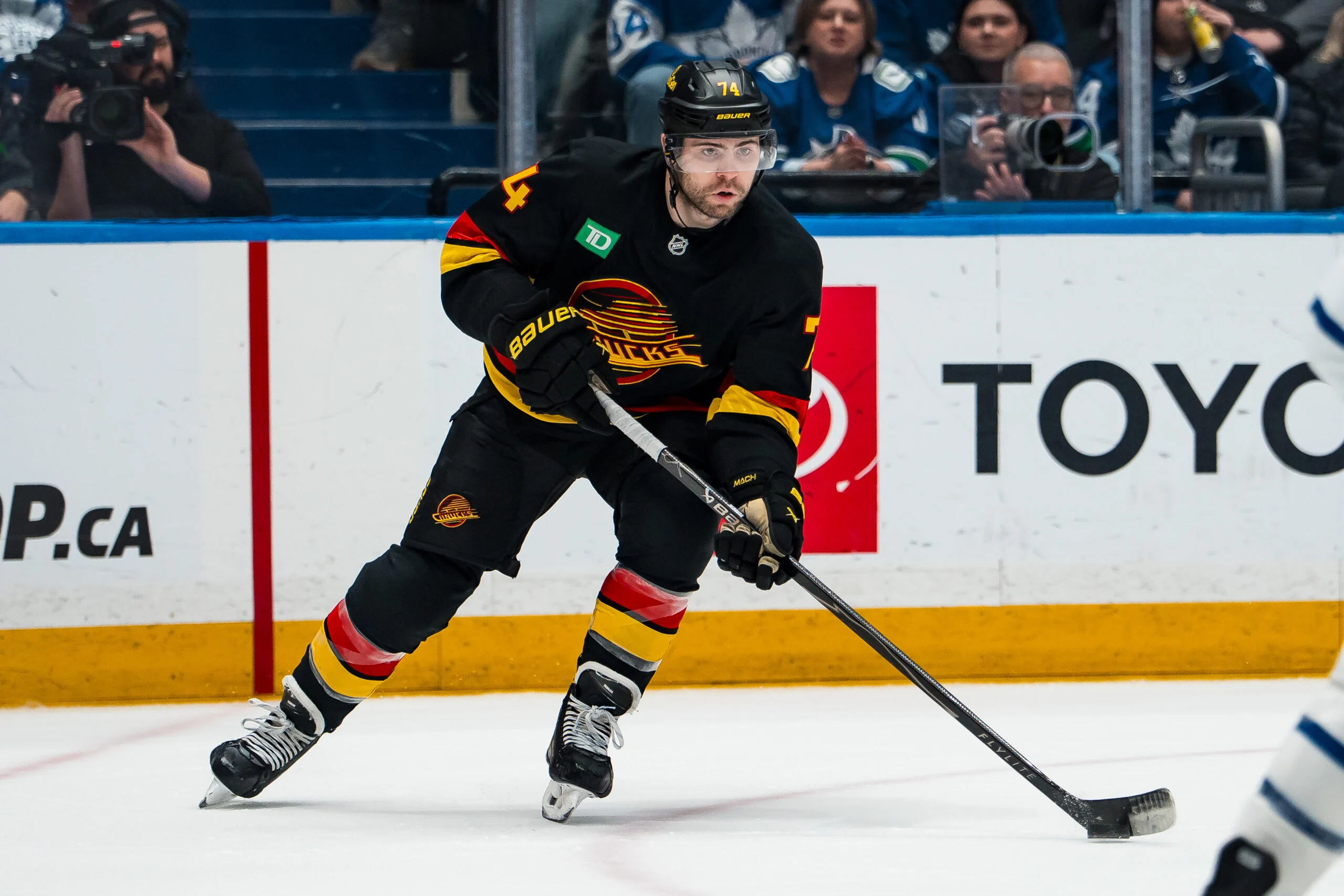
This is why the system matters so much for this specific player. DeBrusk's whole game is volume and getting to the net. Put him on a team that already creates a ton of chances, give him a center who can actually find him and finishers who pull coverage, and you have a top 6 30 goal winger. The shots are already there. The expected goals are already there. All that's missing is the finishing catching back up to the process, and process is the thing that holds.
On a contender with real linemates and a power play to run him on, DeBrusk is a 25-to-30 goal guy. The 23-goal version on a bad team is the floor, not the player. That's exactly the kind of buy-low a smart team makes: acquire a guy whose results are lagging his underlying game, in a spot built to fix it.
What is a pick in this range actually worth?
Everyone clutches first-round picks like they're guaranteed players. I pulled every draft pick from 14th to 32nd overall going back to 2006, through 2018, which is the range old enough that the players have had full careers to play out. That's 13 draft classes and 230 skaters once you take the goalies out. I set two bars. The first is just "did he become an NHL player," which I defined as 150 career games. The second is "did he become an impact player," which I set at a half a point per game for forwards and three tenths for defensemen, on top of the 150 games. Here's what came back:
- Made it to 150 NHL games: 59%. So roughly four in ten picks in this range never even became real NHLers.
- Became an impact player: 22%. Just over one in five.
Picks 14 through 22 hit the NHLer bar 70% of the time but only became impact players 26% of the time. Picks 23 through 32 made the NHL just 49% of the time and were impact players 18% of the time. For forwards specifically, the impact rate across the whole 14-to-32 range was 21%. Across those 13 drafts, the entire 14-to-32 range produced only about two and a half impact forwards per year, league-wide.
If you're holding pick 14, or pick 20, or pick 26, the single most likely outcome is a player who never becomes a difference-maker. You've got somewhere between a one-in-five and one-in-four shot at hitting on an impact player, and you won't know for three or four years.
The fair price for a contender/team on the rise
When you trade that pick for Jake DeBrusk, you are not giving up an impact player. You are giving up a roughly 20% chance at an impact player, four years from now, who you then have to develop and pay. And you're getting back a proven, established top-six winger who drives play and whose goal total is sitting under where his shot profile says it should be, right now, for a team trying to win right now.
A contender's whole job is to convert uncertainty into certainty. The pick is the lottery ticket. DeBrusk is the cash. For a team picking in the 15-to-32 range, the pick was never likely to help this window anyway, because by the time it pays off the window may be closed. Columbus's 14 is the cleanest example of the price point, but other fits are the fringe-and-up teams drafting behind them who need scoring on the wing.
The bottom line
A pick in the 14-to-32 range is an NHLer about 59% of the time and an impact player only 22% of the time, and you wait years to find out which. DeBrusk is a top-six driver whose finishing is the only thing lagging, and finishing is the one skill that comes back. If you're a contender with a hole on the left side and a center to feed him, you take that trade and you don't overthink it. The certainty is worth more than the ticket.
DeBrusk's card is from my model on MoneyPuck data. The draft study I ran myself, pulling every 14-to-32 pick from 2006 through 2018 from NHL draft records and their full career totals, then measuring the 150-game and points-per-game thresholds. Data: MoneyPuck.com and NHL public records.