

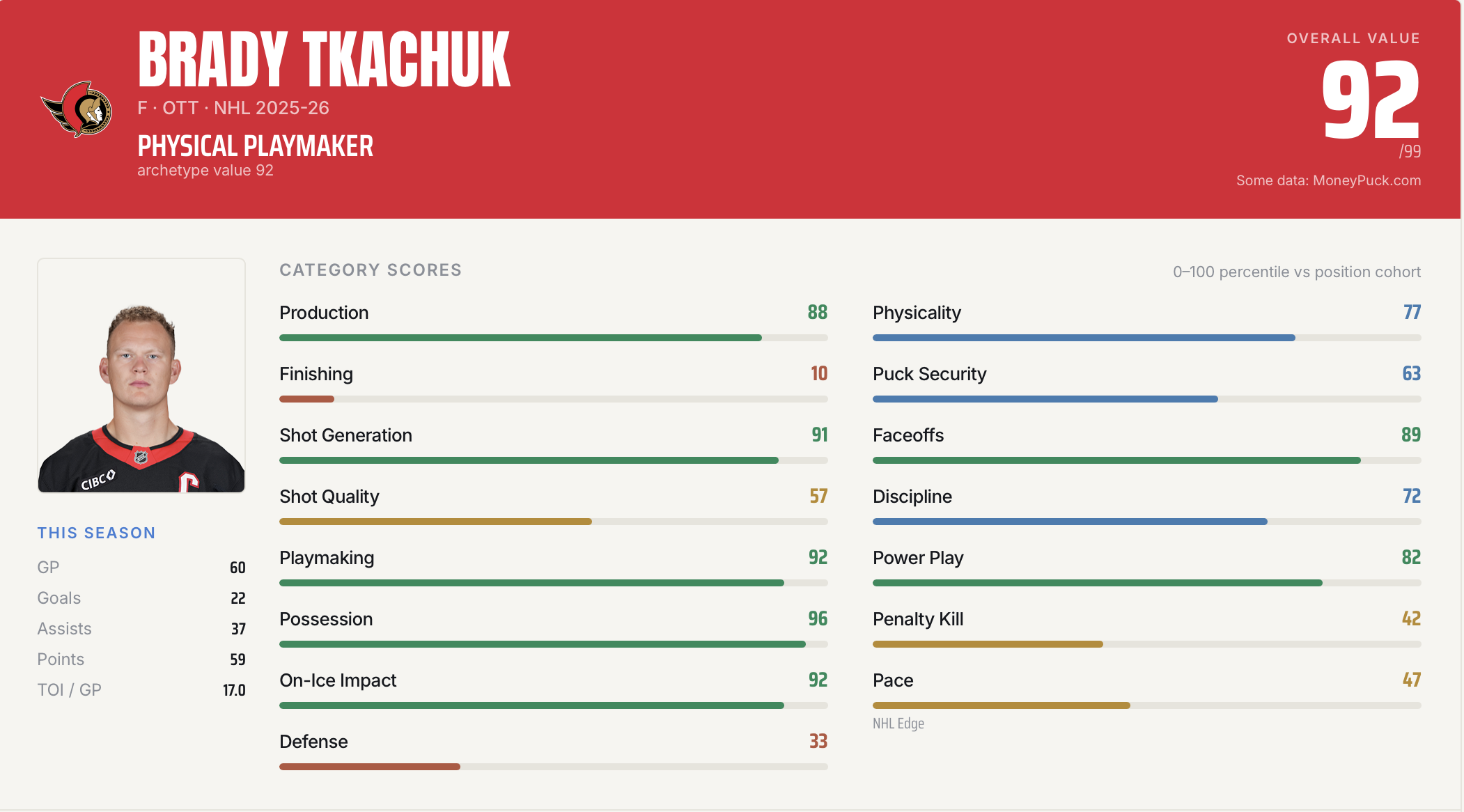
The Senators traded Brady Tkachuk and came out of it now holding the 9th, 25th and 32nd picks in the upcoming draft. That's a big swing for a team that isn't actually rebuilding. Their core is young and good and nowhere near done. So the question for Ottawa isn't whether to tear it down. It's how to replace what Tkachuk gave them and keep competing, with a draft hand that's suddenly loaded.
Meanwhile, Vancouver is shopping three players who happen to plug straight into Ottawa's needs: Brock Boeser, Jake DeBrusk and Filip Hronek. Let me go through the players, the picks, and where everybody fits, because this is one of those rare spots where two teams want exactly what the other one has.
The hole Ottawa just created
Moving Tkachuk takes a power forward off the top six and a ton of net-front offense with him. My needs model already flagged Ottawa for play-driving and defense depth before this, and now there's a top-six winger spot wide open next to Stützle or Dylan Cozens. They have the picks to go get a replacement.
The picks, and which ones to actually spend
I pulled every pick from 14th to 32nd overall going back to 2006. In the 23-to-32 range, only about half of those picks ever became NHL players at all, and just 18% became impact players. Picks 14 through 22 were a little better, 70% NHLers and 26% impact, but still, the most likely outcome of any first-round pick outside the top tier is a guy who never becomes a difference-maker, and you wait three or four years to find out.
So treat Ottawa's three picks completely differently:
- Pick 9 is the one to protect. It sits above the range I studied, which means better odds than any of those numbers, and it's the kind of selection that can actually return a real player. Keep it, or only move it as the centerpiece of something big.
- Picks 25 and 32 are coin flips, by the data. Two more late-first lottery tickets sitting in the exact range where most picks miss. Those are the chips you happily spend on proven NHL players, because you're trading two long shots for a sure thing.
From an Ottawa perspective you want to keep 9, and turn 25 and 32 into players who help Stützle and Batherson win now.
Trade Pieces: Brock Boeser
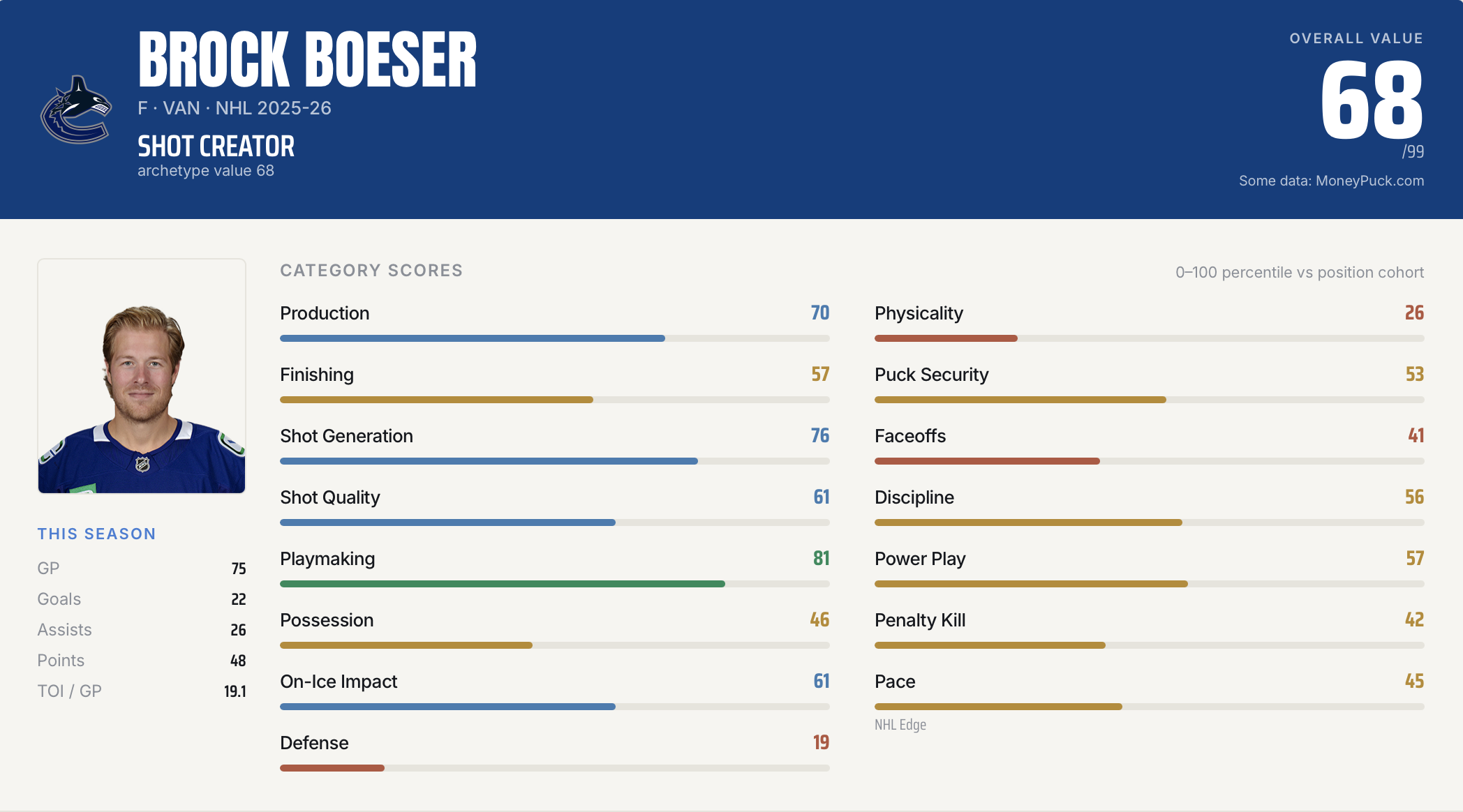
Boeser grades as a 68, a Shot Creator. The card is a scorer's card: playmaking 81, shot generation 76, production 70. He shoots, he finds people, and he produced 22 goals and 48 points this year on offense that mostly came even with his expected total. His negatives: possession 46, defense 19, pace 45. He's not driving play and he's not helping you in his own end, but this defence data has a lot to do with the Canucks being 32nd in the league. He's a finisher you slot next to a center who does the heavy lifting.
In Ottawa that's perfect, because Stützle and Cozens do the heavy lifting. Drop Boeser onto the right side of a scoring line and he's a clean 25-30 goal complement who feasts on the chances those two create.
Jake DeBrusk, the buy-low with the highest ceiling
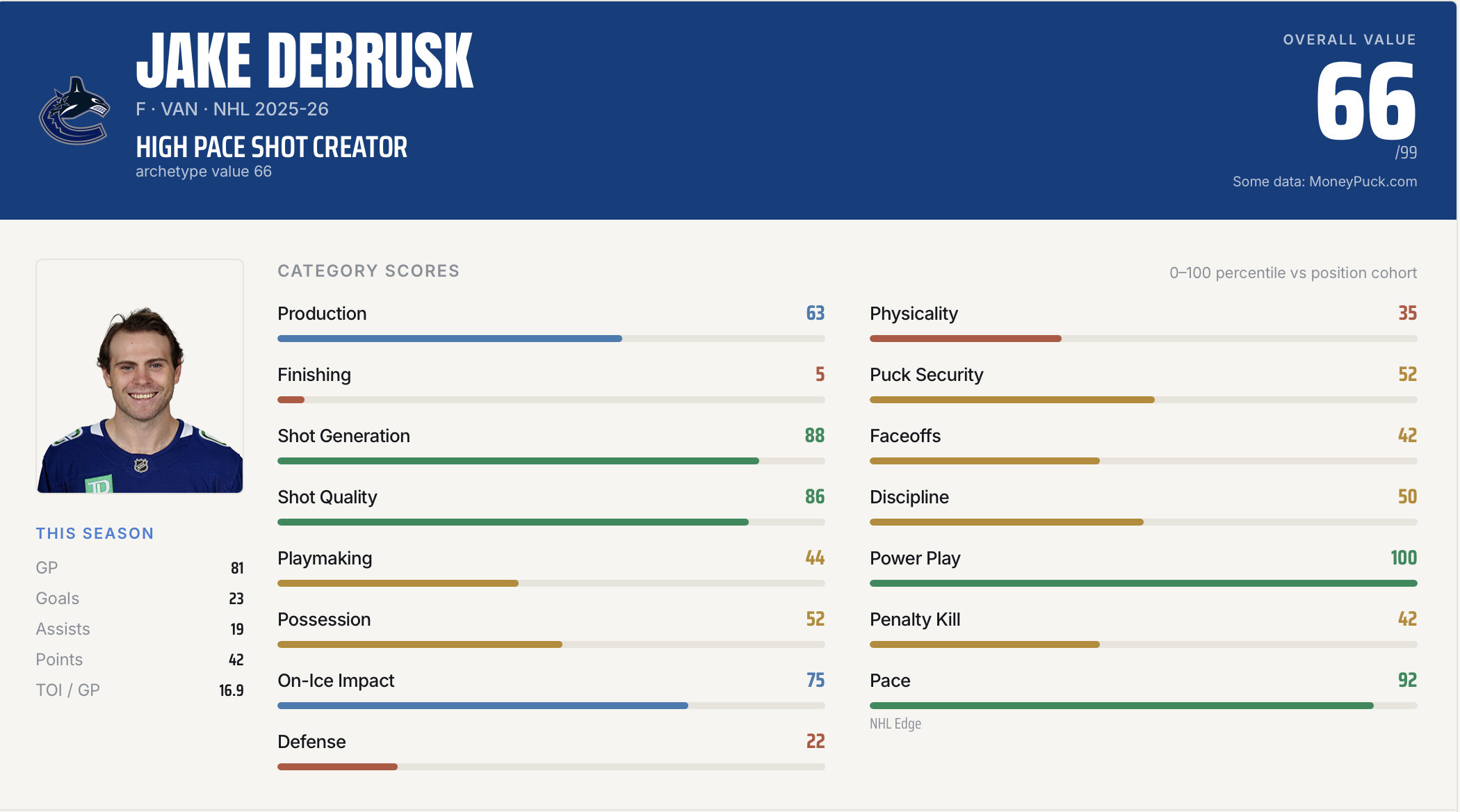
DeBrusk is the one I'd actually chase. He's a 66 on the card but his underlying numbers show that there is more: shot generation 88, shot quality 86, pace 92, and a power play score of 100. He gets to the dangerous areas, shoots constantly, flies in transition, and he's an elite net-front presence on the man advantage, which is exactly the role Tkachuk just vacated.
His finishing graded a 5 this year, about as low as it goes. But look closer: he scored 23 goals on 34.9 expected goals. The chances were there for 35, the puck just didn't go in. Finishing is the hardest skill to evaluate in hockey because it differs from year to year. Shot generation and shot quality, the things he's elite at, are stable. Put DeBrusk on Stützle's wing with a real power play to run him on, and the 23-goal version becomes the 30-goal version.
Filip Hronek
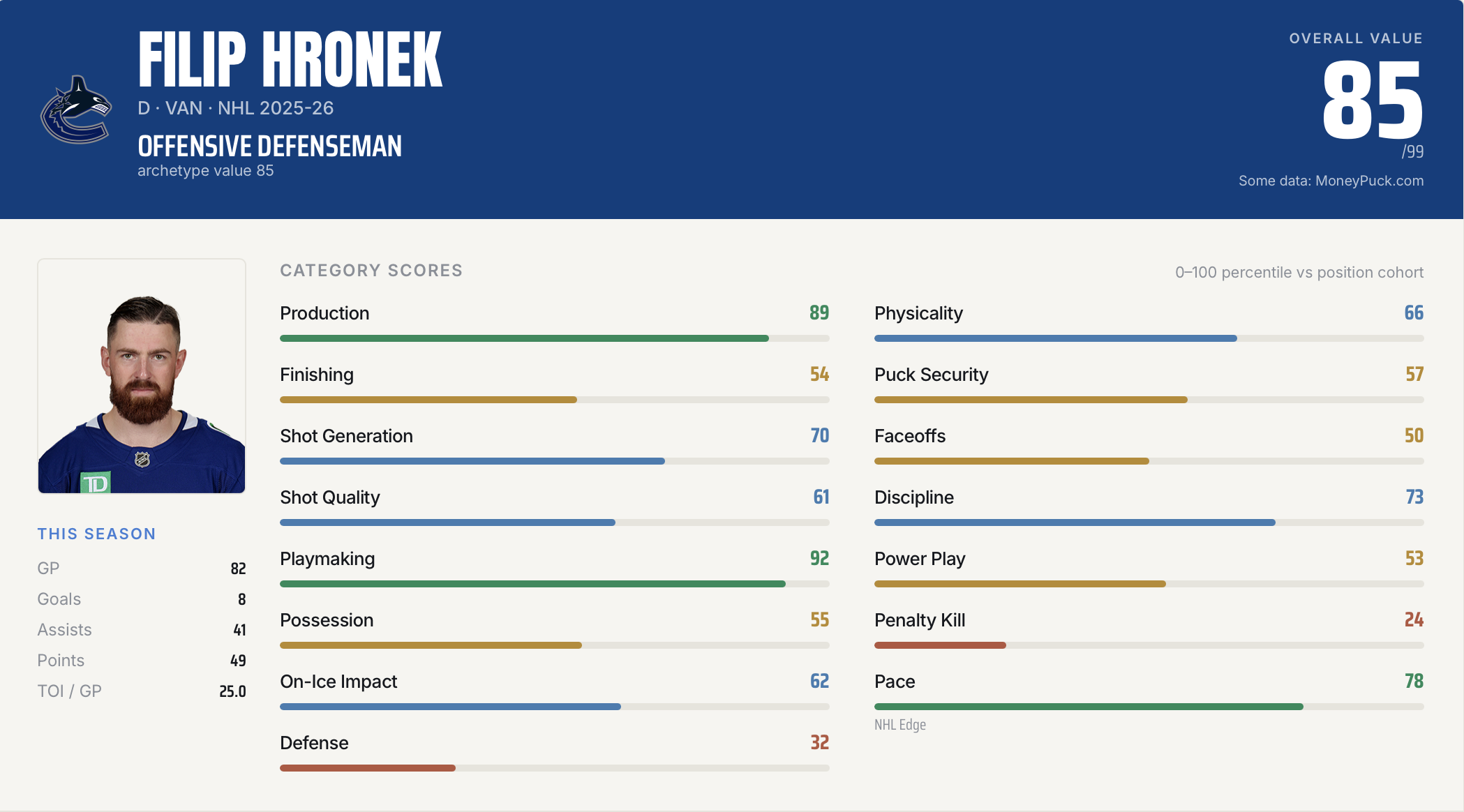
Hronek is the best player of the three, an 85, an Offensive Defenseman. The card shows elite puck-mover traits: production 89, playmaking 92, pace 78, with respectable physicality at 66 and discipline at 73. He logged 25 minutes a night and put up 49 points from the back end. His defense grades a 32 and his on-ice results dipped mostly due to the Canucks struggles.
Chabot and Jordan Spence are a fine top pair, but slide Hronek in next to Chabot and push Spence down, and suddenly Ottawa has two legitimate puck-moving right-side defensemen. The downside of acquiring Hronek is that Ottawa would need to pick between Yakemchuk and Spence because keeping both would hinder their development.
What it could realistically fetch
Boeser and DeBrusk are proven top-six wingers, and a proven top-six winger is roughly what a late first-round pick gets you, the 25 or the 32, maybe with a smaller piece attached. That's a fair swap on both sides: Vancouver gets the futures and the change of scenery it's after, Ottawa converts a coin-flip pick into a player who helps immediately. Doing both, landing one of the wingers with one pick, is very doable.
Hronek is the bigger ask. He's a top-pair defenseman signed long term, and that's the kind of player who costs real assets, the sort of return where Ottawa's 9th pick finally comes into play as a centerpiece rather than something you protect. If Ottawa wanted to make one true splash with this draft capital, Hronek is the player worth the 9 and then some.
The bottom line
Vancouver is selling exactly the players that fill it. Spend 25 and 32 on a winger like DeBrusk or Boeser, who slots next to Stützle and replaces the goals that just left, and keep the 9 unless Hronek is the prize.
All player grades, statlines and team needs are from my model on MoneyPuck data. The draft study I ran myself, every 14-to-32 pick from 2006 through 2018 with their full career totals. Data: MoneyPuck.com and NHL public records.