

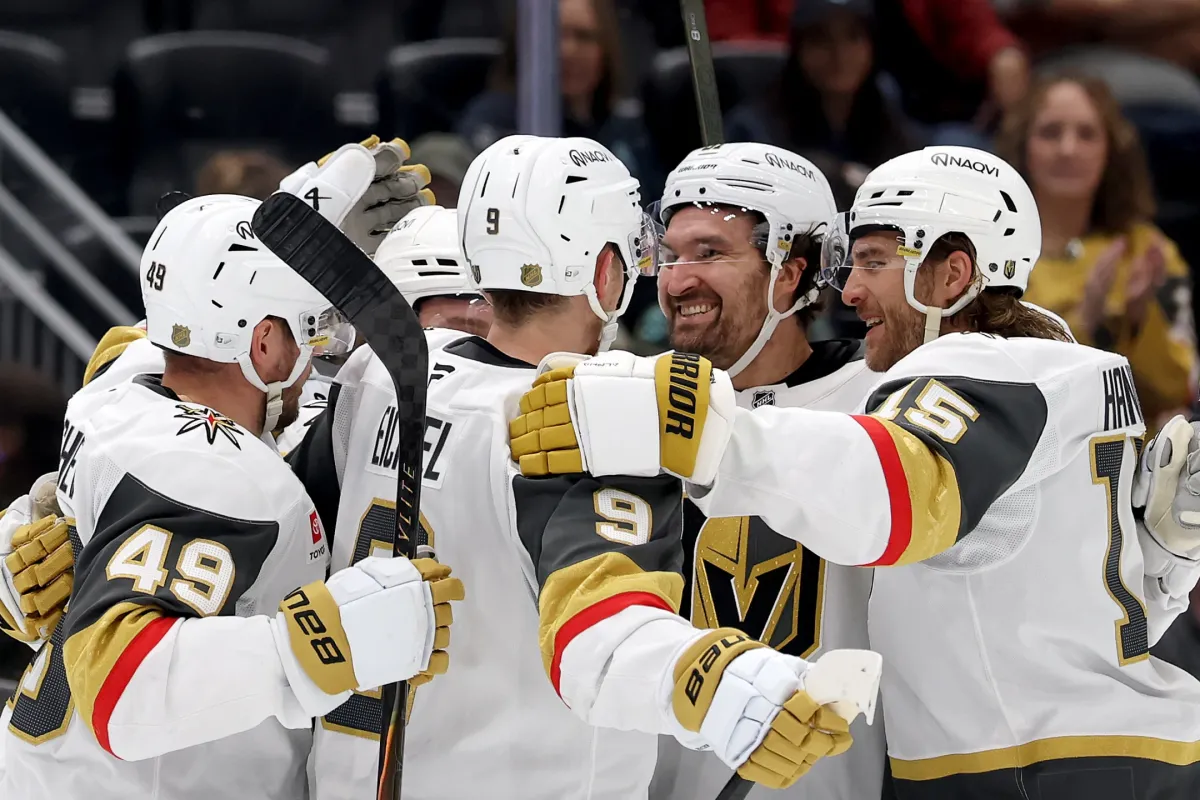
I've been building a hockey model for a while now, and I wanted to point it at one team and really dig in. I picked the Vegas Golden Knights, because no team in my lifetime has been this good this fast. They made the Stanley Cup Final in their very first season, won the whole thing in their sixth, and they're right back in the Final again. For a team that didn't exist before 2017, that's kind of crazy.
So I went through how they actually built their roster, and then I pulled every team's MoneyPuck data going back to their first season and ran Vegas against the rest of the league. A few things really stood out, and honestly some of them surprised me.
How they build the team
The first thing you notice is that Vegas does not really care about the draft. They treat draft picks like money to spend, not like players to develop. More than half of their 2023 Cup-winning roster was acquired in trades. Of the seven first-round picks they've ever made, six are already gone, almost all of them traded away as the main piece to land a proven NHL player. Nick Suzuki went to Montreal in the Pacioretty deal and is now their captain. Erik Brannstrom was the centerpiece for Mark Stone. Peyton Krebs headlined the Jack Eichel trade. As time goes on it's become really clear that this is on purpose. Because of it, Vegas went into this season with no picks in the first two rounds in either 2026 or 2027, and one of the weakest prospect pools in the league. They are completely fine with that, because they keep turning those futures into players who win them games right now.
It started the day the team was born. In the 2017 expansion draft, GM George McPhee didn't just pick good players, he got teams to hand over extra picks and prospects just to control which players Vegas took or avoided. Columbus gave up a first, a second, and ate a bad contract just to steer one pick, and Vegas used it on William Karlsson, who then scored 43 goals. Anaheim threw in Shea Theodore as a sweetener. So instead of building an expansion team slowly like everyone expected, Vegas started loaded and went straight to the Cup Final.
In free agency they're picky. They don't sign a ton of guys. They go big on one or two top names and pay them full price, like Alex Pietrangelo at seven years and $8.8 million a year, and then they clear cap by trading someone else out to make it fit. Below that, they dig for cheap value, undrafted college guys and reclamation projects. There isn't much in the middle. And their biggest stars mostly didn't even come through free agency. They traded for them and signed them after.
The trades are really the engine. When you look at who they go after, it's almost always the same type of player: a proven, prime-age or established star who's big and plays both ends, and they pay in prospects and picks to get him. Pacioretty in 2018 cost them Tomas Tatar, Nick Suzuki, and a second. Mark Stone in 2019 cost Brannstrom, Oscar Lindberg, and a second, and he became the captain. Chandler Stephenson cost a fifth-round pick and turned into a 65-point center, which is highway robbery. Jack Eichel in 2021 cost Alex Tuch, Krebs, a first, and a second. At the 2024 deadline they stacked Tomas Hertl, Noah Hanifin, and Anthony Mantha in one swing. And in 2025 they landed Mitch Marner in a sign-and-trade on an eight-year, $12 million deal, the biggest contract in team history.
The other thing they do, which I really respect even though it's kind of cold, is they trade popular players the second the math stops working. Marc-Andre Fleury was the face of the franchise and a Vezina winner, and they moved him basically for cap relief. Jonathan Marchessault won the Conn Smythe in 2023 and they let him walk a year later over one contract year. In Vegas, the cap sheet wins over feelings every single time.
And then there's the LTIR thing, which is what makes the whole plan work. Mark Stone has gone on long-term injured reserve right before the trade deadline and then come back for Game 1 of the playoffs more than once. That lets Vegas bank his cap space and add around $11 million of talent at the deadline while still being legal, because the cap isn't enforced in the playoffs. Other teams have complained about it, the NHL looked into it, and they cleared Vegas. People call it unsavory but not against the rules, and Vegas just keeps doing it.
What the data says they do differently
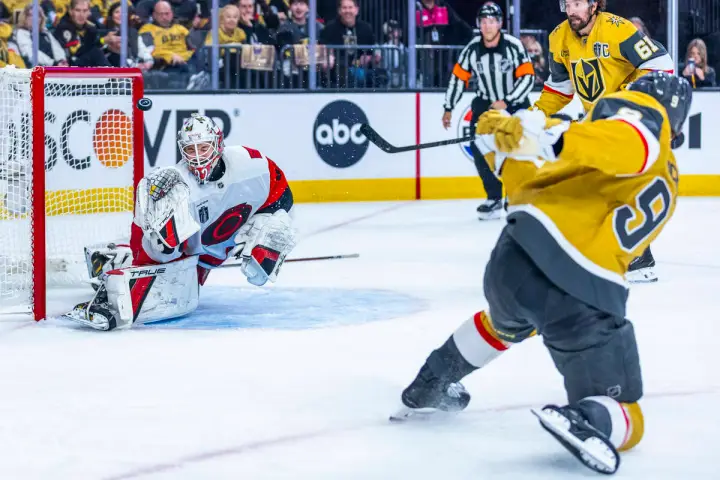
The team-building stuff is pretty well known if you follow them. The part I found more interesting is what the numbers say about how they actually play, because some of it isn't talked about at all. I ranked Vegas against every team each season since 2017-18. Five things really jumped out.
They are the most disciplined team in the league. This is the one nobody mentions. In penalties taken per 60 minutes, Vegas's average rank since 2017 is about 4.6 out of 31-32 teams, and they finished first in the entire NHL in 2022, 2023, and 2024. Three straight years leading the league in just not taking penalties. That means fewer penalty kills, fewer dangerous chances against, and a small edge that adds up over a whole season and a playoff run. No team puts "we don't take penalties" on a banner, but it might be the most consistent advantage they have.
They out-chance teams every single year. Their share of the scoring chances at 5-on-5 has been 55% in 2018, 56% in 2019, 53% in 2020, 52% in 2021, 52% in 2022, 52% in 2023, 53% in 2024, and 54% in 2025. League average every year is about 50%. Their first season they were right at average, and they have never dropped below it since. Every year from their second season on they've created more chances than they give up, for eight years straight. Most good teams have at least one down year in there. Vegas just doesn't. No matter which stars are on the roster, their floor is always above average.
They win on process, not luck. This is the part that told me they're for real and not just getting bounces. Their shooting percentage and PDO, which are the luck-type stats, are only middling, around 15th. So they're not riding a hot goalie or shooters going unconscious. They win by getting more shots and better shots: top-8 in expected goals for, top-8 in high-danger chances, and really good at takeaways, where they force turnovers and score off them. That's a really healthy way to be good, because chances repeat year to year and luck doesn't.
They're big, and they're getting old. Vegas is consistently one of the biggest teams in the league, top-5 in height most years and number one in 2024. And as they've gone all-in on stars, the roster has aged into one of the oldest in the league, moving from 9th oldest in 2021 to 2nd in 2024 and 3rd in 2025. One thing that surprised me: they aren't actually a huge hitting team anymore. Under Gerard Gallant early on they were top-3 in hits, but under Bruce Cassidy they're average. The size shows up more in protecting the puck and reach than in big hits.
They roll four lines, and they spread the minutes. Their depth reputation is real. Vegas gets a smaller share of its scoring from its top three players than almost anyone, which means the scoring is spread all the way down the lineup. In their 2023 Cup season they were the single most balanced scoring team in the entire NHL, with 16 different 20-point scorers. Under Cassidy they also give out ice time more evenly than most teams. They don't win with one line carrying everyone. They win with four lines you can't hide from.
What it all adds up to
When you put it all together, Vegas isn't just a team that makes a lot of aggressive moves. It's one plan, and every part of it fits. They turn picks into proven players. They target big two-way guys who lift the whole team and stay out of the box. They use LTIR and retention to carry more talent than they should be able to, right when it matters in the playoffs. They out-chance and out-discipline teams almost automatically, which gives them a really high floor. And they never get attached to anyone, so the roster always stays sharp. That's why they're rarely the flashiest team by any one stat but they're almost always right there at the end.
The interesting part is where they are right now. This year's team, with Eichel and Marner, is the most top-heavy roster they've ever had, and the pick cupboard is empty. That's kind of a bet against the exact thing that won them the Cup, which was balanced scoring across four lines. It's what happens at the end of an all-in run. Eventually you run out of futures to trade and your best players get old together. Vegas has earned the benefit of the doubt after everything they've pulled off, but for the first time, the way they built this team and the team they actually have are pointing in different directions. That's the thing I'll be watching.
The team-building facts come from NHL.com and beat reporting. The on-ice findings I calculated myself from MoneyPuck team and skater data, ranking Vegas against every NHL team each season from 2017-18 on. Data: MoneyPuck.com.